
ATFirst™ · General health rapid tests
ATFirst™ CEA Rapid Test
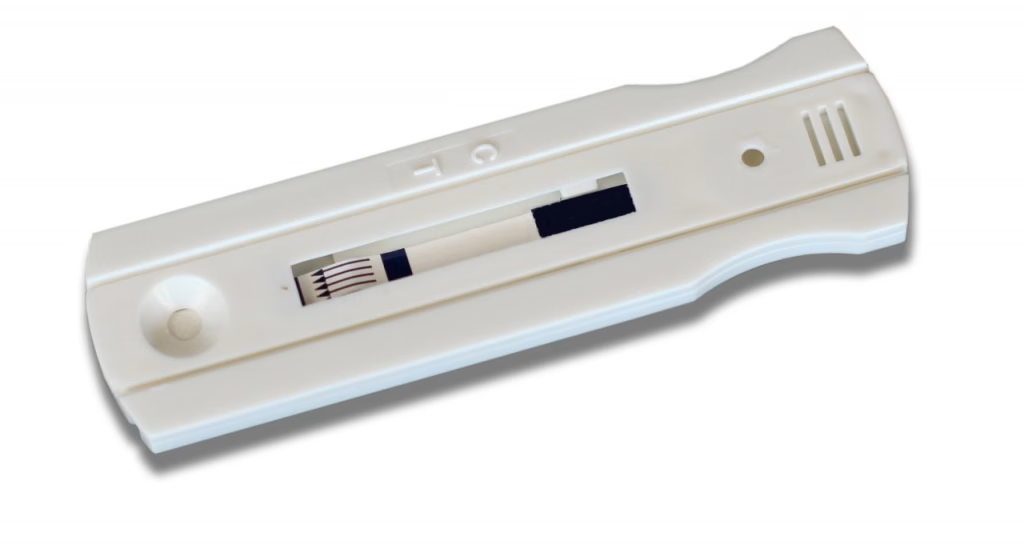
Qualitative detection of carcinoembryonic antigen (CEA) in serum on a lateral flow cassette, for professional use.
- Professional use
- Serum
- 20 tests per kit
Intended use
A CEA rapid test detects carcinoembryonic antigen, a glycoprotein produced during fetal development. Healthy adults have only low levels in the blood. Higher levels are found with some carcinomas, colorectal cancer in particular, and also in smokers and in benign conditions such as inflammatory bowel disease, liver disease and pancreatitis.
The ATFirst™ cassette indicates, qualitatively, whether CEA in a serum specimen exceeds the level defined in the insert. It is an aid for healthcare professionals and is weighed together with other findings. First Diagnostic™ Corporation distributes it with its ATFirst™ rapid tests.
Specifications
| Brand | ATFirst™ |
|---|---|
| Catalog number | 85226400136 |
| Format | Lateral flow cassette |
| Analyte / target | Carcinoembryonic antigen (CEA) |
| Specimen | Serum |
| Pack size | 20 tests — confirm at quotation |
| Intended user | Healthcare professionals |
| Regulatory | Documentation available on request |
| Instructions for use | Supplied with each kit; current insert on request |
How the test works
Serum is added to the sample well and migrates through a pad holding colored particles coated with anti-CEA antibody. Further along the membrane a second antibody to CEA is fixed in a line. In this sandwich design, CEA links the particles to that line and makes it visible, while the control line forms independently. Read the device as the insert instructs. The method is described in lateral flow tests explained.
What to confirm in the insert
In clinical practice CEA is mostly followed as a number over time, so a buyer should know exactly what a yes-or-no cassette reports. The insert supplied with each kit states the detection level and also covers serum preparation and handling, sample volume, read window, storage and interpretation.
Request the current insert from sales@firstdiagnostic.com; the product inserts page holds those already published.
Limitations
- The test does not diagnose or rule out cancer and is not a population screening tool.
- Many tumors do not raise CEA, so a negative result is not reassurance.
- Smoking and several benign conditions raise CEA; a reactive result needs clinical follow-up, not a conclusion.
- Monitoring of patients relies on serial quantitative measurements by the same laboratory method. A qualitative cassette cannot do this.
Frequently asked questions
Can whole blood or plasma be used?
The catalog lists serum for this product. Use only what the insert permits.
Is the test suitable for monitoring treatment?
No. Monitoring needs quantitative laboratory results.
How is it packed?
20 tests per kit, catalog number 85226400136, confirmed at quotation. To become a supplier in your market, use the distributor application.
Related rapid tests
- General health rapid tests — Category overview.
- ATFirst™ PSA rapid test — Prostate-specific antigen.
- ATFirst™ AFP rapid test — Alpha-fetoprotein.
- Tumor antigen detection — Background article.
Quote request: CEA rapid test
Send us your requirements and we will return pricing with the current insert.
Source: First Diagnostic™ product catalog. The instructions for use were not available when this page was written · Last reviewed: October 2026 · First Diagnostic™ editorial team
Regulatory status: Products shown on this website are for professional in vitro diagnostic use. They are not cleared, approved or authorized by the U.S. Food and Drug Administration and are not offered for sale in the United States. Product availability and regulatory status vary by country; contact us for the status in your market.