
ATFirst™ · Respiratory rapid tests
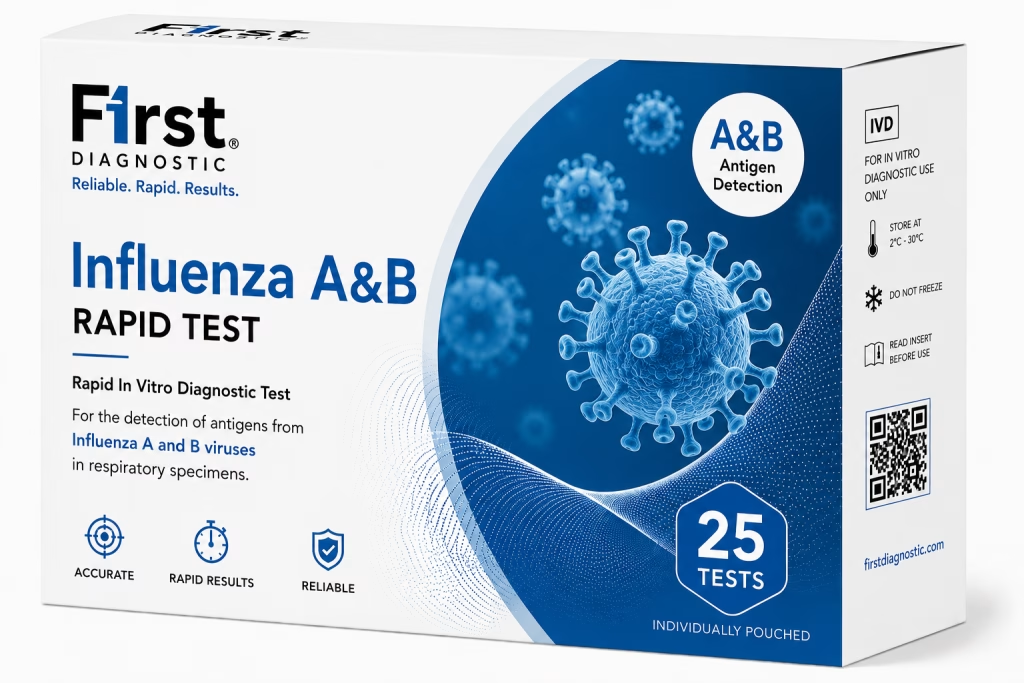
ATFirst™ Flu A & B – Influenza A & B Rapid Test
A rapid qualitative test that detects influenza type A and type B nucleoprotein antigens in nasal swab, nasopharyngeal swab and nasopharyngeal aspirate/wash specimens, read at 10–15 minutes. For professional in vitro diagnostic use.
- Professional use
- Antigen test
- Read at 10–15 minutes
- Separate A and B test lines
Intended use
The ATFirst™ Flu A & B test from First Diagnostic™ Corporation is an influenza A & B rapid test: an in vitro rapid qualitative test that detects influenza type A and type B nucleoprotein antigens directly from nasal swab, nasopharyngeal swab and nasopharyngeal aspirate/wash specimens from patients with signs and symptoms of respiratory infection.
It is intended for professional and laboratory use, to aid in the rapid differential diagnosis of influenza A and B viral infections. Negative results are presumptive. See our respiratory rapid tests in the rapid tests catalog.
Specifications
| Brand | ATFirst™ |
|---|---|
| Catalog number | 85226400110 |
| Format | Test device with built-in Extraction Well; two test lines (A and B) and a control line (C) |
| Target | Influenza A and influenza B nucleoprotein antigens, qualitative |
| Specimen | Nasal swab, nasopharyngeal swab, nasopharyngeal aspirate/wash |
| Time to result | Read at 10–15 minutes |
| Read window | Confirm negative results at 15 minutes |
| Kit size | 20 tests per kit (see kit label) |
| Kit contents | Individually pouched test devices; Extraction Reagent in capsules (300 µL); sterile swabs; 1 positive control swab; 1 negative control swab; package insert; procedure card |
| Required but not provided | Timer; latex gloves. For aspirate/wash specimens: bottled Extraction Reagent and transfer pipettes, available separately |
| Storage | 2–30 °C in the original sealed pouch, away from direct sunlight |
| Intended user | Healthcare professionals |
| Regulatory | Documentation available on request |
| Source document | Sample laboratory procedure 1531-1, 10/2016 |
How the influenza A & B rapid test works
The test combines chemical extraction of viral antigen with an antigen-capture immunoassay. The specimen sits for one minute in the Extraction Well of the device, where antigen is extracted from disrupted virus particles.
The solution then migrates through pads containing detector antibodies conjugated to gold dye and on through the test membrane. Influenza antigen bound to dye-labeled antibody is captured by anti-influenza antibody immobilized at the A or B test line, producing a colored line. The control line (C) shows that sufficient sample was applied. See our guide to lateral flow tests.
Test procedure at a glance
Swab procedure. Wash and aspirate specimens follow a separate procedure that uses bottled Extraction Reagent.
- Prepare. Bring reagents, specimens and devices to room temperature (18–30 °C). Place the device on a level surface.
- Add the Extraction Reagent. Tear the tab off the capsule and squeeze all of the solution into the Extraction Well.
- Extract the swab. Collect the specimen with the swab provided in the kit. Insert the swab in the Extraction Well and rotate it 3 times. Incubate for 1 minute, rotate 3 times again, then remove and discard the swab.
- Start the flow. Raise the device upright, let it stand for 1–2 seconds and tap it gently so that the liquid flows into the hole. Lay it flat again and start timing.
- Read the result. Read at 10–15 minutes. Confirm negative results at 15 minutes.
This summary does not replace the instructions for use supplied with the kit.
Reading results
- Influenza A positive: reddish purple lines at the A and C positions.
- Influenza B positive: reddish purple lines at the B and C positions. Even a light or faint test line is interpreted as positive.
- Negative: a control line (C) only. Do not call a negative result before 15 minutes.
- Invalid: no line at the control position in 15 minutes. Repeat with a new device.
Re-test specimens that are positive on both the A and B lines, and confirm repeatable dual positives by cell culture or PCR before reporting.
Cross-reactivity and interfering substances
The source for this page is a laboratory procedure that contains no sensitivity or specificity figures, so none are given here; see product inserts.
According to the procedure, none of the non-influenza organisms tested gave a positive result. The panel included adenovirus, human coronavirus, cytomegalovirus, enterovirus, Epstein-Barr virus, human parainfluenza types 1, 2 and 3, measles, human metapneumovirus, mumps virus, respiratory syncytial virus type B and rhinovirus type 1A, and bacteria such as Streptococcus pneumoniae and Staphylococcus aureus.
Substances reported to have no inhibitory effect at the concentrations tested include mucin, whole blood, phenylephrine, oxymetazoline, zanamivir, mupirocin and tobramycin.
Limitations
- A negative result does not exclude infection with influenza A or B and should not be the sole basis for treatment or other management decisions. The procedure recommends confirming negative results by viral culture.
- The test distinguishes influenza A from influenza B but cannot differentiate subtypes, and a positive result does not rule out co-infection with other pathogens.
- Performance characteristics were established during the 2007-2009 influenza seasons and may vary against other emerging influenza viruses.
- Testing specimens from adults gives lower sensitivity than testing specimens from children, who tend to shed more virus.
- People who received nasally administered influenza A vaccine may test positive for up to three days after vaccination.
- The test has not been evaluated in patients without signs and symptoms of respiratory infection or in immunocompromised individuals.
Downloads
This document is a sample laboratory procedure, not the full package insert. The package insert is supplied with each kit.
- ATFirst™ Flu A & B test – sample laboratory procedurePDF · Sample laboratory procedure · 1531-1, 10/2016
Frequently asked questions
How many tests are in a kit?
20 tests per kit (see kit label).
How long can specimens be held before testing?
Test fresh specimens immediately. If necessary, swab samples may be stored for up to 4 hours at room temperature or up to 8 hours at 2–8 °C.
Are controls included?
Yes. The kit contains one positive control swab and one negative control swab.
How can we order or become a distributor?
Email sales@firstdiagnostic.com for a quotation, or complete the distributor application. Regulatory documentation is available on request.
Related rapid tests
- Respiratory rapid tests — The ATFirst™ respiratory range and tests available on request.
- ATFirst™ CRP rapid test — C-reactive protein test from the ATFirst™ range.
- ATFirst™ Malaria P.f. rapid test — Antigen test for P. falciparum in whole blood.
- ATFirst™ Dengue IgG/IgM rapid test — IgG and IgM antibodies to dengue virus.
- Lateral flow tests explained — How lateral flow tests work.
Request a quote for the ATFirst™ Flu A & B rapid test
First Diagnostic brands and distributes lateral flow rapid tests made by established IVD manufacturers, for customers outside the United States. Tell us your market and volume, and we will reply with pricing and documentation.
Source: ATFirst™ Flu A & B Test sample laboratory procedure, document 1531-1, 10/2016 (not the full package insert) · Last reviewed: October 2026 · First Diagnostic™ editorial team
Regulatory status: Products shown on this website are for professional in vitro diagnostic use. They are not cleared, approved or authorized by the U.S. Food and Drug Administration and are not offered for sale in the United States. Product availability and regulatory status vary by country; contact us for the status in your market.