
Resource center · Early cancer diagnostics
Rapid diagnostic technologies: what is changing
Rapid diagnostic technologies are moving beyond the visually read strip. This guide describes five directions of development, what each adds and what each demands from the user.
- Educational guide
- Reviewed October 2026
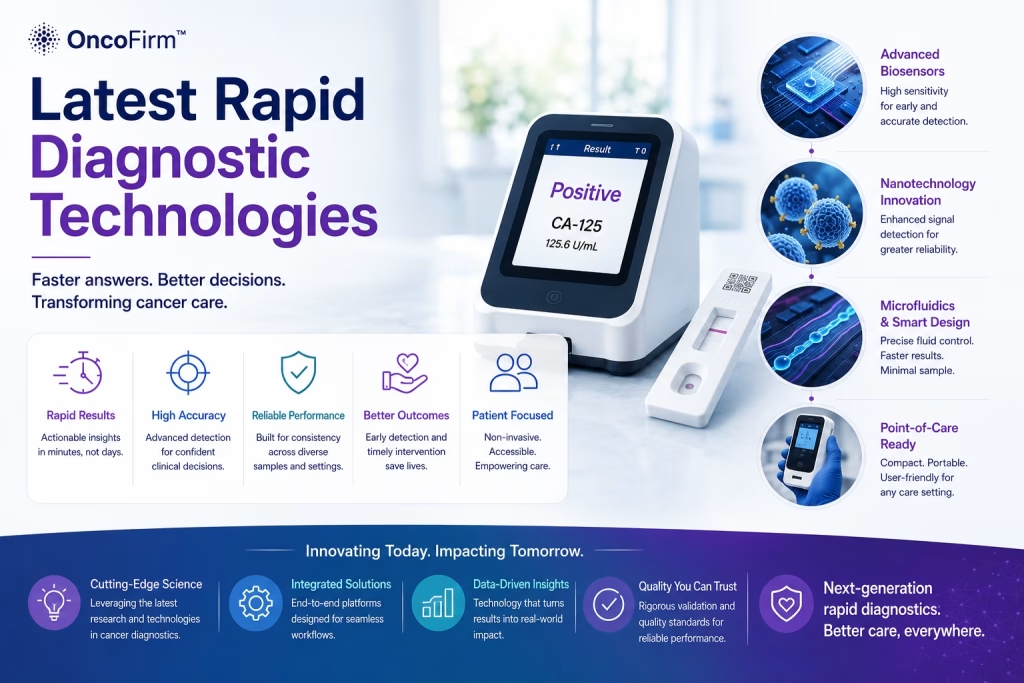
The starting point for rapid diagnostic technologies
Most rapid diagnostic technologies in routine use share one design: a lateral flow test with colored particles, usually colloidal gold, that form a visible line when the target is present. The result is read by eye in minutes, with no instrument. The guide to how lateral flow assays work covers the mechanism.
That design has known limits. The result is qualitative, sensitivity is bounded by what the eye can see, each strip covers few analytes, and the result is not recorded unless someone writes it down. Each direction below addresses one of these limits. None is free: each adds cost, equipment or complexity, and each must be validated for its intended use.
Fluorescent labels and quantitative readers
Replacing colored particles with photoluminescent labels changes what can be measured. A published review of these reporters notes that a gold line can be read without any device, whereas luminescent labels allow quantitative detection from the amount of light emitted, measured with a strip reader. Label types include quantum dots, lanthanide chelates such as europium, and upconverting phosphors. Lanthanide labels permit time-resolved measurement, which reduces background signal.
The trade-off is the instrument. A fluorescent test cannot be read by eye, the reader needs calibration and maintenance, and reader and test are normally supplied as a matched system. See fluorescent vs gold nanoparticle labels for a fuller comparison.
Multiplexing: several analytes from one specimen
Multiplex tests report more than one result from a single specimen. A review of multiplex lateral flow immunoassays describes three approaches: several test lines on one strip, which is the most common; several strips in one housing that share a sample; and labels that give distinguishable signals at a single site.
The same review lists the costs. Closely spaced lines are harder to tell apart, and spacing them out uses more sample and membrane and lengthens the assay. Each analyte in a panel also needs its own performance evaluation. Combination rapid tests such as the HIV / HBsAg / HCV combo test are established examples of the multi-line approach.
Digital readout and connectivity
Readers for visually read tests photograph or scan the cassette and record the result. WHO has published a target product profile for such readers, stating that they promote more consistent test performance, interpretation and reporting. It covers dedicated instruments and mobile applications, and it separates readers that only record the user’s interpretation from readers that give a diagnostic interpretation and are regulated as medical devices.
For a laboratory or programme, the practical gains are a stored record and the option to transfer results to an information system. The practical questions are which tests a reader is validated for and how data are protected. More in digital cassette readers for lateral flow tests.
Isothermal molecular tests and CRISPR-based detection
Antigen and antibody tests detect proteins. Molecular tests detect nucleic acid and answer a different question, typically whether a pathogen’s genetic material is present.
Isothermal amplification
Loop-mediated isothermal amplification (LAMP) copies a target sequence at a constant temperature, given in one review as between 60 and 65 °C, so it does not need the thermal cycler that PCR requires. The same review notes the drawbacks: LAMP uses four to six primers, primer design is demanding, non-specific amplification can cause false positives, and multiplexing in a single tube is difficult.
CRISPR-based detection
CRISPR-based tests use Cas12 or Cas13 enzymes that, once they recognize a target sequence, also cut nearby reporter molecules, a property called collateral cleavage. The cut reporter produces a fluorescent signal or a line on a lateral flow strip. A review of the field states that sensitivity depends mainly on an amplification step run first, and that amplification-free versions still require nucleic acid extraction, which keeps them impractical for point-of-care use until that step is removed.
Technology directions compared
What each direction adds to a visually read lateral flow test and what it requires
| Direction | What it adds | What it requires |
|---|---|---|
| Fluorescent labels with a reader | Quantitative result; lower detection limits in some assays | Matched reader, calibration, higher equipment cost |
| Multiplex strips | Several results from one specimen | Evaluation of every analyte; more demanding visual reading |
| Digital readers and connectivity | Consistent reading; stored and transferable results | Validation for each test; data management |
| Isothermal amplification | Nucleic acid detection without a thermal cycler | Heating step, demanding primer design, control of non-specific amplification |
| CRISPR-based detection | Sequence-specific readout by fluorescence or strip | Prior amplification and sample preparation in most designs |
Summary of the reviews listed in the references; individual products differ.
Where First Diagnostic fits
First Diagnostic™ Corporation distributes visually read rapid tests for professional in vitro diagnostic use; it does not supply fluorescent, molecular or CRISPR-based tests. Its range includes qualitative tumor-marker tests, listed with the tumor-marker and general health rapid tests, which are aids used alongside other clinical findings and are not cancer screening or diagnostic tools. An interest in rapid cancer-marker testing and digital cassette readers is a longer-term goal, with nothing available yet. To discuss current products, contact First Diagnostic.
Frequently asked questions
Do fluorescent tests replace visually read rapid tests?
No. They serve different needs. Visually read tests need no instrument and suit sites without equipment support. Fluorescent tests add quantification but depend on a matched reader.
Are molecular rapid tests the same as lateral flow tests?
No. Molecular tests detect nucleic acid after an amplification step; lateral flow immunoassays detect antigens or antibodies. Some molecular tests use a lateral flow strip only to display the final result.
Does a digital reader improve the test itself?
A reader standardizes how the result is read and recorded. It does not change the chemistry of the strip, and it should be used only with tests it has been validated for.
What should a distributor ask about a new rapid test format?
Ask for the intended use, the performance data in the instructions for use with the comparator method and sample size, the equipment and consumables required, the storage conditions and the regulatory documentation for the destination market.
Keep reading
- Lateral flow tests explained — The pillar guide to how lateral flow rapid tests are built, read and evaluated.
- How lateral flow assays work — The strip components and the sandwich and competitive assay formats.
- Fluorescent vs gold nanoparticle labels — How the two label types compare for sensitivity, quantification and equipment.
- Digital cassette readers for lateral flow tests — What a reader does, what it does not change and what to ask before using one.
- Point-of-care testing: where rapid tests fit — Settings, workflows and quality requirements for near-patient testing.
References
- Danthanarayana AN, Brgoch J, Willson RC. Photoluminescent Molecules and Materials as Diagnostic Reporters in Lateral Flow Assays. ACS Applied Bio Materials. 2022;5(1):82–96. doi:10.1021/acsabm.1c01051. pmc.ncbi.nlm.nih.gov
- Anfossi L, Di Nardo F, Cavalera S, Giovannoli C, Baggiani C. Multiplex Lateral Flow Immunoassay: An Overview of Strategies towards High-throughput Point-of-Need Testing. Biosensors. 2019;9(1):2. doi:10.3390/bios9010002. pmc.ncbi.nlm.nih.gov
- World Health Organization. Target product profile for readers of rapid diagnostic tests. 2023. who.int
- Yang N, Zhang H, Han X, Liu Z, Lu Y. Advancements and applications of loop-mediated isothermal amplification technology: a comprehensive overview. Frontiers in Microbiology. 2024;15:1406632. doi:10.3389/fmicb.2024.1406632. pmc.ncbi.nlm.nih.gov
- Brogan DJ, Akbari OS. CRISPR Diagnostics: Advances toward the Point of Care. Biochemistry. 2023;62(24):3488–3492 (published online 2022). doi:10.1021/acs.biochem.2c00051. pmc.ncbi.nlm.nih.gov
Source: First Diagnostic™ editorial team; sources listed above · Last reviewed: October 2026 · First Diagnostic™ editorial team
Regulatory status: Products shown on this website are for professional in vitro diagnostic use. They are not cleared, approved or authorized by the U.S. Food and Drug Administration and are not offered for sale in the United States. Product availability and regulatory status vary by country; contact us for the status in your market.