
Resource center · Early cancer diagnostics
Fluorescent lateral flow assay vs colloidal gold: how the labels compare
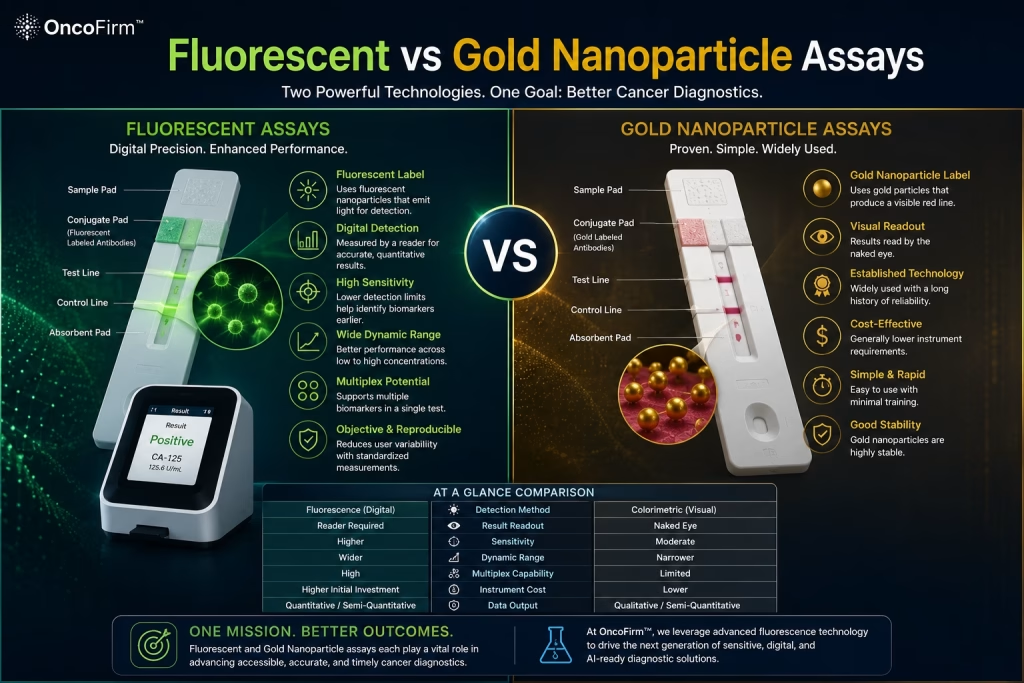
A fluorescent lateral flow assay uses a light-emitting label and an instrument reader in place of the visible red line produced by colloidal gold. This guide compares the two label types for sensitivity, equipment and workflow.
- Educational guide
- Reviewed October 2026
What the label does in a lateral flow test
In a lateral flow test the label, also called the reporter, is the particle or molecule attached to the detection antibody. When the antibody is captured at the test line, the label makes the line detectable. A published review of reporter technologies describes reporter particles as among the most significant components of the assay, because they perform the readout and dictate the sensitivity of the test.
The choice is between labels seen by eye, chiefly colloidal gold, and labels measured by an instrument, such as those used in a fluorescent lateral flow assay. The strip works in the same way in both cases; see how lateral flow assays work.
Colloidal gold: the visually read label
Colloidal gold is a suspension of gold nanoparticles. The particles absorb light strongly, so those captured at the test line form a red to purple band that is visible without equipment. Gold nanoparticles are frequently used as reporters and produce the familiar line of most visually read lateral flow tests.
The strengths are practical: no reader, no power supply, a stable signal and a simple yes-or-no result. The limits are those of the eye. Faint lines are judged differently by different readers, the result is qualitative, and very low concentrations may not produce a visible line.
How a fluorescent lateral flow assay differs
A fluorescent lateral flow assay replaces the colored particle with a label that emits light when illuminated at a suitable wavelength. Labels described in the literature include organic fluorophores, quantum dots, lanthanide chelates such as europium, and upconversion phosphors.
The signal is not read by eye. The cassette is placed in a reader that illuminates the membrane, measures the light emitted at the test and control lines, and converts it into a result. With lanthanide labels the reader can use time-resolved measurement: the label continues to emit after short-lived background fluorescence from the membrane and sample has faded, which improves the ratio of signal to background.
Sensitivity and quantitation: what published work shows
The review cited below concludes that, in most cases, photoluminescent reporters show enhanced sensitivity compared with conventional gold nanoparticle assays, and that they can support quantitative and multiplex detection. As one example, a study of a europium-nanoparticle assay for free PSA reported a detection limit approximately 100-fold lower than that of the most sensitive gold-particle lateral flow assays in the published literature.
Such figures need context. They are analytical results from research assays, in that study with antigen spiked into pooled serum, and they do not describe the clinical performance of any commercial product. Antibody quality, membrane, sample type and reader design all contribute, so a fluorescent test is not automatically more sensitive than a well-optimized gold test.
Instrument reading has a benefit of its own. For rapid influenza tests, CDC notes that those read by an analyzer device standardize result interpretation and have higher sensitivity than those read without one.
Colloidal gold and fluorescent labels compared
General characteristics of the two label types in lateral flow tests.
| Feature | Colloidal gold | Fluorescent label |
|---|---|---|
| How the line is read | By eye; an optical reader is optional | By a dedicated fluorescence reader |
| Equipment needed | None for visual reading | A reader matched to the cassette |
| Result type | Qualitative; semi-quantitative with some readers | Qualitative or quantitative, depending on the product |
| Analytical sensitivity | Limited by what the eye can distinguish | Often higher in published comparisons; depends on the whole assay |
| Interpretation | Depends on the reader’s judgment of faint lines | Standardized by the instrument |
| Best suited to | Sites without equipment or reliable power | Sites that can maintain a reader and need numeric or recorded results |
General characteristics; individual products differ. The product insert and reader manual define the intended use.
Practical trade-offs for buyers
A fluorescent system is a cassette plus an instrument. Buyers take on the purchase or placement of readers, calibration and quality control, power or battery supply, operator training and service. Cassettes generally work only with the reader they were designed for, which ties the consumables to one supplier.
In return, the reader removes subjective line reading, can store or transmit results, and can report a number where the test is calibrated for it. For point-of-care testing in clinics without reliable power or maintenance, visually read rapid tests remain the practical choice. Gold-based cassettes can also be read by digital cassette readers, a middle route discussed with other developments in rapid diagnostic technologies.
What the label choice means for tumor-marker testing
Protein tumor markers are mostly used to follow a trend over time, which needs a number. That is why monitoring is done on quantitative laboratory immunoassays, and why fluorescent strips are studied for markers such as PSA. A qualitative gold test answers a narrower question: whether the marker is above the cut-off defined in the insert.
Neither label changes the clinical limits of the marker itself. A lower detection limit does not make a marker more specific for cancer; see tumor antigen detection.
Where First Diagnostic fits
First Diagnostic™ Corporation distributes lateral flow rapid tests for professional in vitro diagnostic use, including qualitative PSA, CEA and AFP tests in its tumor-marker and general health range. These are aids used alongside other clinical and laboratory findings, not cancer screening or diagnostic tools. Reader-based and rapid cancer-marker testing are longer-term interests for the company, and nothing in either area is available yet. For current products, contact the sales team.
Frequently asked questions
Is a fluorescent lateral flow assay always more sensitive than a gold one?
No. Published reviews report better detection limits for fluorescent and other photoluminescent labels in most comparisons, but sensitivity depends on the whole assay: antibodies, membrane, sample and reader. Compare products on the performance data in their inserts, not on label type.
Can a colloidal gold test give a numeric result?
Some gold-based cassettes are paired with an optical reader that measures line intensity and reports a numeric value. This applies only where the product is designed, calibrated and labeled for it; a visually read test is qualitative.
Which label is better for tumor-marker tests?
It depends on the intended use. A qualitative result against a cut-off can be obtained with a visually read gold test. Following a marker over time needs quantitative values, which are normally produced by laboratory immunoassay analyzers.
Keep reading
- How lateral flow assays work — Strip components, sandwich and competitive formats, and reading results.
- Digital cassette readers for lateral flow tests — What instrument reading adds to a visually read cassette.
- Rapid diagnostic technologies: what is changing — Labels, readers and formats now entering use.
- Tumor antigen detection — Antigen classes, immunoassay methods and the limits of protein tumor markers.
- Lateral flow tests explained — The pillar guide: what lateral flow tests are, where they are used and how to choose them.
References
- Photoluminescent Molecules and Materials as Diagnostic Reporters in Lateral Flow Assays (review). ACS Applied Bio Materials. 2022. doi:10.1021/acsabm.1c01051. PubMed PMID 35014811. pubmed.ncbi.nlm.nih.gov
- High-sensitivity lateral flow immunoassay with a fluorescent lanthanide nanoparticle label (research article, abstract). PubMed PMID 30529084. pubmed.ncbi.nlm.nih.gov
- Centers for Disease Control and Prevention. Rapid Influenza Diagnostic Tests. Accessed October 2026. cdc.gov
- World Health Organization, Global Malaria Programme. How malaria RDTs work. Accessed October 2026. who.int
Source: First Diagnostic™ editorial team; sources listed above · Last reviewed: October 2026 · First Diagnostic™ editorial team
Regulatory status: Products shown on this website are for professional in vitro diagnostic use. They are not cleared, approved or authorized by the U.S. Food and Drug Administration and are not offered for sale in the United States. Product availability and regulatory status vary by country; contact us for the status in your market.