Resource center · Early cancer diagnostics
AI in cancer diagnostics: current uses, evidence and limits
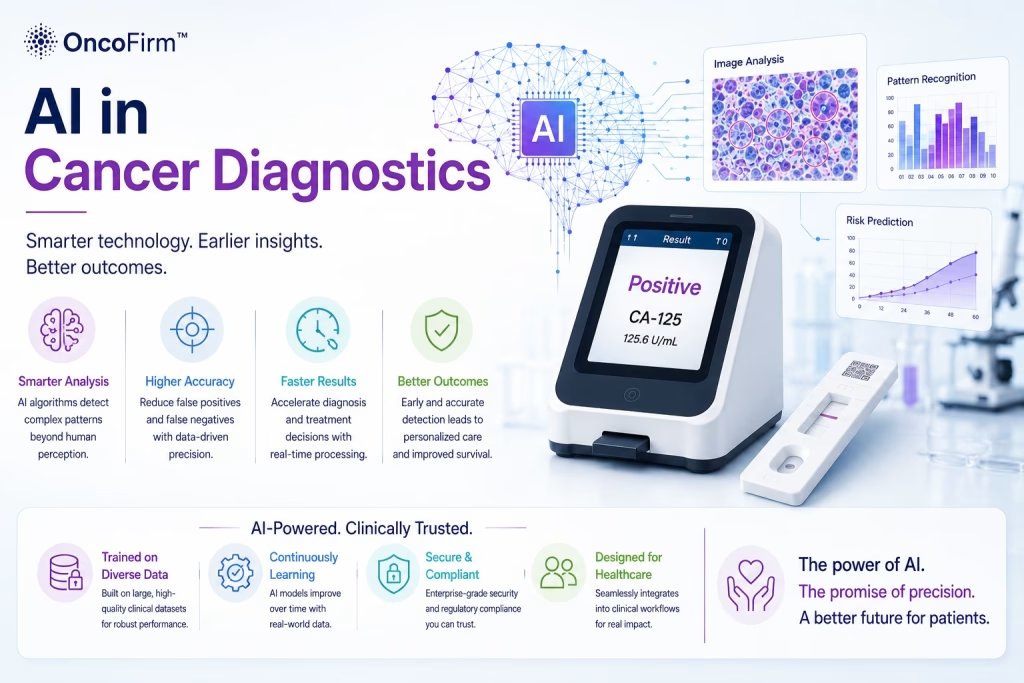
AI in cancer diagnostics refers to software that helps clinicians read images, slides and test results. This guide covers where it is used, how it is regulated and what its limits are.
- Educational guide
- Reviewed October 2026
What AI in cancer diagnostics means
AI in cancer diagnostics is the use of machine-learning software to analyze medical data, most often images, and to give a clinician an output such as a marked region, a score or a suggested classification. The models are trained on large sets of labeled examples and learn statistical patterns from them.
Two points frame everything else. First, these tools support a qualified reader; they do not replace the clinical work-up. Second, software intended to help diagnose disease is regulated as a medical device in many jurisdictions, so it needs evidence and review for its stated purpose, as an instrument or an in vitro diagnostic test does.
Where AI is used in cancer care
Medical imaging
Imaging is the most developed area. The U.S. National Cancer Institute (NCI) notes that medical images such as mammograms can be processed rapidly with the help of AI, and that imaging algorithms have been studied both for detecting breast cancer on mammography and for predicting a person’s long-term risk of invasive breast cancer.
Digital pathology
Once glass slides are scanned, software can highlight regions for the pathologist to examine. The NCI reports that software of this kind has been authorized in the United States to help pathologists identify areas of prostate biopsy images that may contain cancer. NCI researchers have also developed a method for automated detection of precancerous cervical lesions from digital images.
Reading rapid tests
Image analysis can also be applied to lateral flow tests. A reader or phone application captures an image of the cassette and measures the test and control lines instead of relying on the eye. WHO has published a target product profile for readers of rapid tests, stating that readers promote more consistent test performance, interpretation and reporting. It distinguishes readers that only record the user’s interpretation from readers that provide a diagnostic interpretation and are regulated as medical devices. More in digital cassette readers for lateral flow tests.
AI applications at a glance
Three areas where software assists a qualified reader
| Area | What the software does | What a buyer or user should check |
|---|---|---|
| Mammography | Marks suspicious regions or scores an examination for the radiologist | Authorization in your country; evidence from populations similar to yours |
| Digital pathology | Highlights areas of a scanned slide for the pathologist | Compatibility with the scanner and stains in use; the pathologist remains responsible for the report |
| Rapid test readers | Measures line intensity from an image of the cassette | Which specific tests the reader is validated for; whether it interprets the result or only records it |
Summary of the sections above; not a list of specific products.
How AI diagnostic software is regulated
Regulators review AI-enabled devices before they are marketed. The U.S. Food and Drug Administration publishes a list of AI-enabled medical devices authorized for marketing in the United States. It states that devices on the list have met the applicable premarket requirements, including a focused review of overall safety and effectiveness, and that the list is not comprehensive.
The U.S., Canadian and UK regulators have also issued joint guiding principles on transparency for machine-learning-enabled devices. They ask that users be told the intended use, the performance, known biases or failure modes, how the output is meant to inform a health care decision, and which patient groups were poorly represented in the training or clinical data.
Authorization in one country does not carry over to another. A distributor or laboratory should confirm the status of any software in its own market and for the specific use intended.
Limits of AI in cancer diagnostics
- Bias. The NCI warns that models trained on data that are not diverse and representative of the wider population can perpetuate medical bias.
- Clinical evidence. The NCI also points to a need for further randomized clinical trials to validate AI applications in practice. Good performance on a stored data set does not show that patients do better.
- Explainability. Many models cannot show why they reached an output, which makes errors harder to detect.
- Input quality. Software cannot recover information that the image or the assay did not capture. A reader does not make a nonspecific biomarker more specific.
- Governance. WHO guidance on AI for health asks that ethics and human rights be placed at the heart of design, deployment and use.
For these reasons AI outputs belong inside the normal diagnostic pathway. Positive findings still need confirmation, and negative findings do not exclude disease. Related reading: the future of cancer screening and what are cancer biomarkers.
Where First Diagnostic fits
First Diagnostic™ Corporation distributes rapid tests for professional in vitro diagnostic use; it does not supply AI software. Its range includes qualitative tumor-marker tests, listed with the tumor-marker and general health rapid tests, which are aids interpreted alongside other clinical and laboratory findings and are not cancer screening or diagnostic tools. The company’s interest in rapid cancer-marker testing and digital cassette readers is a longer-term goal, and nothing in this area is available yet. Questions about the current catalog can be sent through the contact page.
Frequently asked questions
Can AI diagnose cancer on its own?
No. Current tools give an output for a qualified reader to review. Diagnosis remains the responsibility of the clinician and, in most cases, depends on pathology.
Does AI diagnostic software need regulatory review?
Software intended to help diagnose disease is generally regulated as a medical device and must meet the requirements of each country where it is marketed. Ask the supplier for the authorization that applies in your market and the intended use it covers.
Can AI read a lateral flow test?
Image-analysis readers can measure test and control lines and record the result. A reader should be used only with the tests it has been validated for, and a reader that interprets results is itself a regulated device.
Does First Diagnostic offer an AI reader?
No. A digital cassette reader is a longer-term interest, not an available product.
Keep reading
- Lateral flow tests explained — The pillar guide to how lateral flow rapid tests are built, read and evaluated.
- Digital cassette readers for lateral flow tests — What a reader does, what it does not change and what to ask before using one.
- The future of cancer screening — Established screening methods and the approaches still being evaluated in trials.
- Point-of-care oncology — What near-patient cancer-marker testing can and cannot show.
- Rapid diagnostic technologies: what is changing — Fluorescent readers, multiplexing, digital readout and molecular formats compared.
References
- National Cancer Institute. AI and Cancer. cancer.gov
- U.S. Food and Drug Administration. Artificial Intelligence-Enabled Medical Devices. fda.gov
- U.S. Food and Drug Administration, Health Canada and MHRA. Transparency for Machine Learning-Enabled Medical Devices: Guiding Principles. fda.gov
- World Health Organization. Target product profile for readers of rapid diagnostic tests. 2023. who.int
- World Health Organization. Ethics and governance of artificial intelligence for health: WHO guidance. 2021. who.int
Source: First Diagnostic™ editorial team; sources listed above · Last reviewed: October 2026 · First Diagnostic™ editorial team
Regulatory status: Products shown on this website are for professional in vitro diagnostic use. They are not cleared, approved or authorized by the U.S. Food and Drug Administration and are not offered for sale in the United States. Product availability and regulatory status vary by country; contact us for the status in your market.