
ATFirst™ · Hepatitis and HIV rapid tests
ATFirst™ HCV Rapid Test for Hepatitis C Virus Antibodies
A lateral flow test device for the qualitative detection of antibodies to hepatitis C virus (HCV) in whole blood, serum or plasma. The result is read at 10 minutes.
- Professional use
- Result in 10 minutes
- Whole blood, serum or plasma
- Antibody test
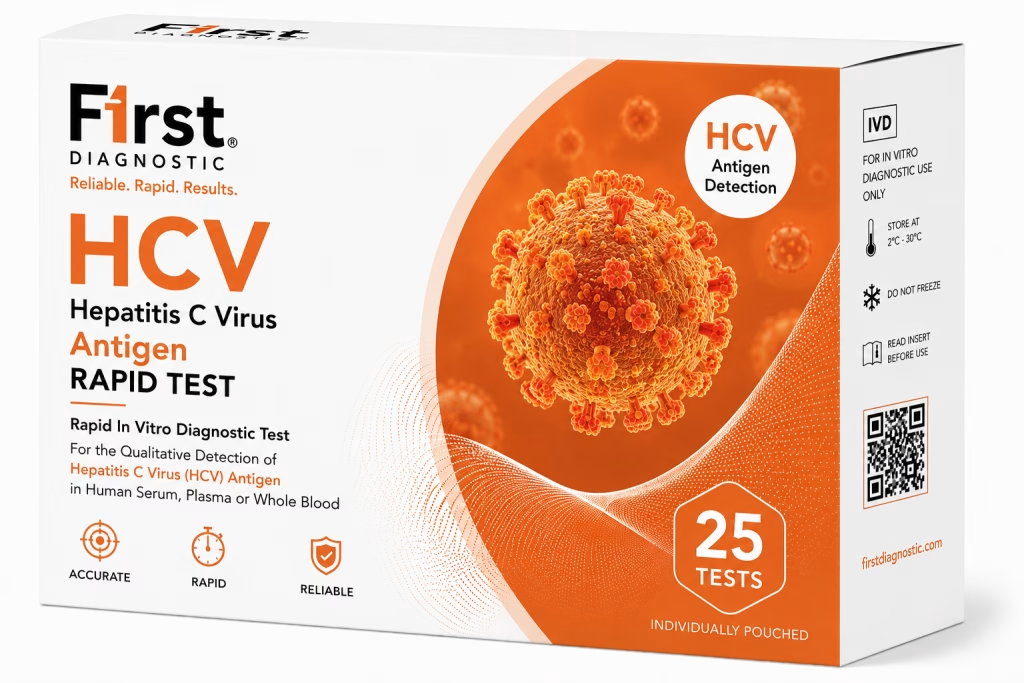
Intended use of the HCV rapid test
The ATFirst™ HCV rapid test is a rapid chromatographic immunoassay for the qualitative detection of antibody to hepatitis C virus (HCV) in whole blood, serum or plasma. It is for professional in vitro diagnostic use only.
The test indicates only the presence of antibodies to HCV in the specimen; it does not detect viral antigen or RNA. Results are an aid to diagnosis and must be interpreted by a clinician with other clinical and laboratory findings.
First Diagnostic™ Corporation brands and distributes this test within its catalog of rapid tests.
Specifications
| Brand | ATFirst™ |
|---|---|
| Catalog number | 85226400070 |
| Format | Lateral flow test device with specimen well (S), test line (T) and control line (C) |
| Analyte / target | Antibodies to hepatitis C virus (HCV) |
| Specimen | Whole blood (venipuncture or fingerstick), serum or plasma |
| Sample volume | Serum or plasma: 4 drops (approximately 100 µl). Whole blood: 1 drop (approximately 25 µl), then 1 drop of buffer (approximately 40 µl). |
| Time to result | Read at 10 minutes |
| Read window | Do not interpret the result after 20 minutes |
| Kit contents | Test devices, disposable specimen droppers, buffer (for whole blood only), package insert |
| Storage | 2–30 °C in the sealed pouch; do not freeze |
| Intended user | Healthcare professionals |
| Regulatory | Documentation available on request |
| Insert document | No. R015574-02, effective date 0802 |
How the test works
This lateral flow test is a membrane-based immunoassay for antibody detection. The test line region is coated with recombinant HCV antigen. The insert states that the recombinant proteins are encoded by genes for both structural (nucleocapsid) and non-structural proteins.
During testing, the specimen reacts with protein A coated particles. The mixture migrates along the membrane by capillary action and reacts with the recombinant HCV antigen, generating a colored line if antibody to HCV is present. A colored line in the control region (C) shows that enough specimen was added and that membrane wicking occurred.
Test procedure at a glance
- Bring to room temperature. Allow the test device, specimen and buffer to reach room temperature (15–30 °C). Remove the device from the foil pouch, place it on a clean and level surface and use it as soon as possible.
- Serum or plasma. Hold the dropper vertically, transfer 4 drops of serum or plasma (approximately 100 µl) to the specimen well (S) and start the timer.
- Whole blood. Transfer 1 drop of venipuncture whole blood (approximately 25 µl) with the dropper, or approximately 25 µl of fingerstick whole blood by capillary tube or as 1 hanging drop, to the specimen well (S). Then add 1 drop of buffer (approximately 40 µl) and start the timer.
- Read the result. Read the result at 10 minutes. Do not interpret the result after 20 minutes.
This summary does not replace the instructions for use supplied with the kit.
Reading results
- Positive: two distinct red lines appear, one in the control region (C) and one in the test region (T). Any shade of red in the test region should be considered positive.
- Negative: one red line appears in the control region (C). No apparent red or pink line appears in the test region (T).
- Invalid: the control line fails to appear. Insufficient specimen volume or incorrect procedural technique are the most likely reasons. Repeat the test with a new device.
Control standards are not supplied with the kit. The insert recommends testing positive and negative controls as good laboratory practice.
Performance
HCV Rapid Test Device compared with a leading commercial HCV EIA test using clinical specimens (291 results), as printed in the product insert.
| HCV rapid test result | EIA positive | EIA negative | Total |
|---|---|---|---|
| Positive | 145 | 2 | 147 |
| Negative | 0 | 144 | 144 |
| Total | 145 | 146 | 291 |
Percentages printed in the insert: relative sensitivity >99.0%, relative specificity 98.6%, accuracy 99.3%. Source: product insert.
Limitations
- The test is qualitative. Neither the quantitative value nor the rate of increase in HCV antibodies can be determined.
- It indicates only the presence of antibodies to HCV and should not be the sole criterion for diagnosing hepatitis C infection.
- A negative result at any time does not preclude the possibility of HCV infection. If the result is negative and clinical symptoms persist, follow-up testing with other clinical methods is recommended.
- All results must be considered with the other clinical information available to the physician.
- Humidity and temperature can adversely affect results.
Downloads
The package insert supplied with the kit is the reference document for this test.
- ATFirst™ HCV rapid test – package insertPDF · No. R015574-02
Frequently asked questions
How long can specimens be kept?
Serum and plasma may be stored at 2–8 °C for up to 3 days, or below -20 °C for long-term storage. Venipuncture whole blood should be stored at 2–8 °C if the test is to be run within 2 days and must not be frozen. Fingerstick whole blood should be tested immediately.
How should the kit be stored?
At room temperature or refrigerated (2–30 °C). Keep the test device in its sealed pouch until use and do not freeze it.
What does the kit contain?
Test devices, disposable specimen droppers, buffer for whole blood and the package insert. Lancets and heparinized capillary tubes for fingerstick sampling are not provided. The insert does not state the pack size; confirm it on your quotation.
What documentation is available?
The package insert is listed with our other product inserts and instructions for use. Regulatory documentation is available on request.
How do distributors order?
Complete the distributor application or email sales@firstdiagnostic.com with catalog number 85226400070 and the quantity you need.
Related rapid tests
- Hepatitis and HIV rapid tests — The full category of hepatitis and HIV tests.
- ATFirst™ HBsAg rapid test — Detects hepatitis B surface antigen in whole blood, serum or plasma.
- ATFirst™ HIV / HBsAg / HCV combo rapid test — HIV 1/2 antibodies, HBsAg and HCV antibodies on one cassette with three test lines.
- ATFirst™ HIV 1-2-O tri-line rapid test — Antibody test for HIV-1, including group O, and HIV-2 in whole blood, serum or plasma.
- Lateral flow tests explained — How lateral flow tests work and where they are used.
Request a quote for the ATFirst™ HCV test
Tell us your market, the catalog number and your expected volumes. First Diagnostic supplies professional buyers outside the United States.
Source: HCV Hepatitis C Virus Rapid Test Device (Whole Blood/Serum/Plasma) package insert, No. R015574-02, effective date 0802; catalog number from the First Diagnostic™ product catalog · Last reviewed: October 2026 · First Diagnostic™ editorial team
Regulatory status: Products shown on this website are for professional in vitro diagnostic use. They are not cleared, approved or authorized by the U.S. Food and Drug Administration and are not offered for sale in the United States. Product availability and regulatory status vary by country; contact us for the status in your market.