
Resource center · Early cancer diagnostics
Point-of-care oncology: what near-patient testing can and cannot do
Point-of-care oncology covers cancer-related tests run near the patient instead of in a central laboratory. This guide sets out what such tests can show, where their limits lie and what remains research.
- Educational guide
- Reviewed October 2026
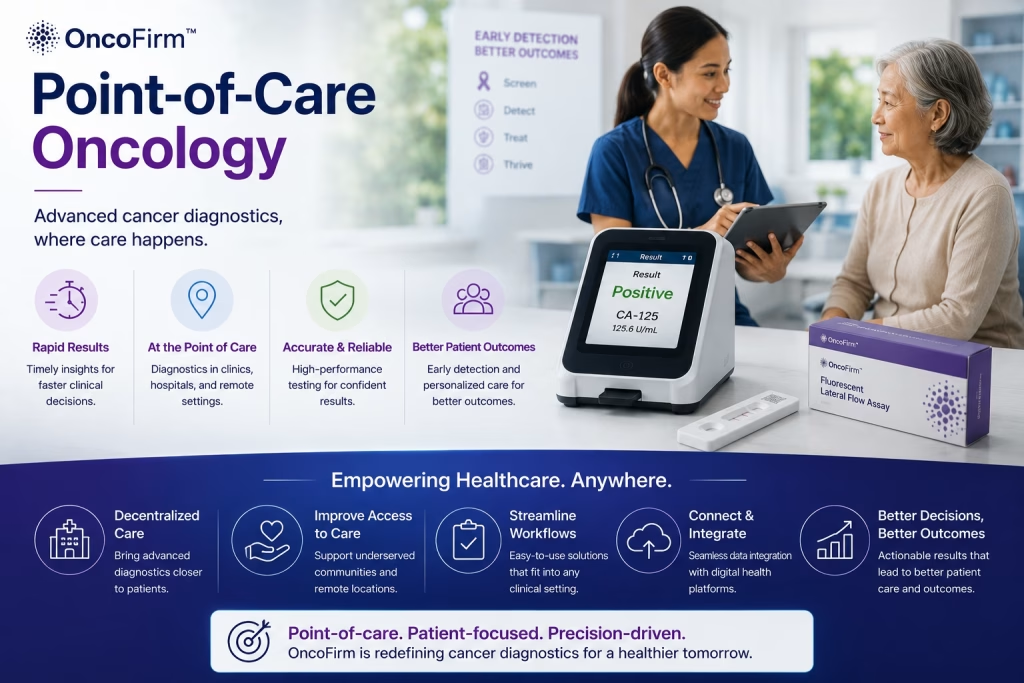
What point-of-care oncology means
Point-of-care oncology is an informal term for cancer-related testing done close to the patient, in a clinic, ward or outreach setting, with a result available during the same visit. It is not a regulatory category. It can refer to a compact analyzer, a portable imaging device or a single-use lateral flow test read within minutes.
The term needs careful handling because cancer is not diagnosed at the point of care. A diagnosis depends on clinical examination, imaging and, in most cases, examination of tissue by a pathologist. What a near-patient test can add is one piece of information sooner: a marker result that supports a referral decision in a patient already being assessed.
What makes a test suitable for near-patient use
A widely cited framework for point-of-care diagnostics is the REASSURED set of criteria: real-time connectivity, ease of specimen collection, affordable, sensitive, specific, user-friendly, rapid and robust, equipment-free or simple, and deliverable to end users. The criteria were written with infectious disease testing in resource-limited settings in mind, but they describe the trade-offs for any near-patient test.
In oncology the two hardest criteria are sensitivity and specificity. Many tumor-associated markers are also produced by normal tissue, and their blood levels overlap between people with cancer, people with benign conditions and healthy people.
Tumor markers at the point of care
The U.S. National Cancer Institute (NCI) describes a tumor marker as anything present in or produced by cancer cells, or by other cells in response to cancer or certain benign conditions, that provides information about a cancer. It states the limits plainly: noncancerous conditions can raise the level of a tumor marker, and not everyone with a given cancer has a raised level. For that reason marker measurements are usually combined with other tests.
Prostate-specific antigen (PSA) shows the problem. PSA is made by normal as well as malignant prostate cells, benign prostatic hyperplasia and prostatitis can raise it, and, according to the NCI, no single threshold separates a normal from an abnormal result.
Qualitative and quantitative formats
Laboratories measure markers such as PSA, carcinoembryonic antigen (CEA) and alpha-fetoprotein (AFP) on quantitative immunoassay analyzers that report a concentration. Qualitative rapid tests for the same markers show a visible line when the level in the specimen is above a fixed cutoff. They do not report a number, so they cannot show how far above the cutoff a level is or how it changes between visits.
More detail is in the guides to cancer biomarkers and tumor antigen detection.
Early diagnosis and screening are different uses
The World Health Organization (WHO) separates two approaches. Early diagnosis means identifying cancer as early as possible in people who already have symptoms. Screening means testing people without symptoms to find cancer or pre-cancer before symptoms appear. WHO lists three components of early diagnosis: awareness of symptoms, access to clinical evaluation and diagnostic services, and timely referral for treatment.
This distinction decides what evidence a near-patient test needs. A test used by a clinician in a patient with symptoms, as one input to a referral decision, has a different intended use from a test offered to healthy people. WHO states that screening programmes should go ahead only when their effectiveness has been demonstrated and when facilities exist to diagnose and treat those who test positive.
WHO also names the harms of screening: false positives that lead to further testing and anxiety, false negatives that give false reassurance, overdiagnosis and overtreatment. A point-of-care format removes none of them. See why early detection matters.
Limits to check before using a near-patient cancer-marker test
- Intended use. The instructions for use define the specimen, the cutoff and the purpose. A test should not be used for a purpose its documentation does not cover.
- Result type. A qualitative result cannot be used to follow a marker over time. Monitoring after treatment, for example PSA after surgery or radiotherapy, relies on quantitative laboratory measurement.
- Confirmation. A positive result calls for laboratory measurement and clinical work-up. A negative result does not exclude disease.
- Operator and quality control. Results depend on correct specimen volume, timing and storage. Staff need training and a quality-control routine.
- Regulatory status. Status differs by country and by product. Buyers should ask for the documentation that applies in their market.
Fluorescent labels, instrument readers and multi-marker panels are being studied as ways to improve sensitivity and add quantification; see rapid diagnostic technologies: what is changing. Each new format has to be validated for its stated purpose before clinical use.
Where First Diagnostic fits
First Diagnostic™ Corporation distributes rapid tests for professional in vitro diagnostic use, including qualitative PSA, CEA and AFP tests listed with the tumor-marker and general health rapid tests. These tests are aids that a clinician interprets together with other clinical and laboratory findings; they are not cancer screening or diagnostic tools. First Diagnostic’s interest in rapid cancer-marker testing and in digital cassette readers is a longer-term goal, and nothing in this area is available yet. For product documentation or supply questions, contact the team.
Frequently asked questions
Can a point-of-care test diagnose cancer?
No. A cancer diagnosis rests on clinical assessment, imaging and, in most cases, pathology. A near-patient marker test gives one piece of supporting information, and both positive and negative results need interpretation by a clinician.
What is the difference between a qualitative and a quantitative tumor-marker test?
A qualitative test reports whether the marker is above a fixed cutoff. A quantitative test reports a concentration, which is needed to compare results over time. Most rapid cassette tests read by eye are qualitative.
Are rapid tumor-marker tests suitable for cancer screening?
No. Screening people without symptoms requires evidence that a programme does more good than harm, plus organized follow-up. Qualitative tumor-marker rapid tests are not validated for that purpose; they are aids used alongside other findings.
Why can a tumor marker be raised when there is no cancer?
Many markers are also produced by normal tissue, and benign conditions can raise them. PSA, for example, can rise with benign prostatic hyperplasia or prostatitis.
Keep reading
- Lateral flow tests explained — The pillar guide to how lateral flow rapid tests are built, read and evaluated.
- What are cancer biomarkers? — Types of biomarker, what they are used for and why few are suitable for screening.
- Tumor antigen detection — How immunoassays measure tumor-associated proteins such as PSA, CEA and AFP.
- Liquid biopsy explained — What blood-based tumor DNA testing measures and where it is used.
- AI in cancer diagnostics — Where diagnostic software is used, how it is regulated and what its limits are.
References
- Land KJ, Boeras DI, Chen XS, Ramsay AR, Peeling RW. REASSURED diagnostics to inform disease control strategies, strengthen health systems and improve patient outcomes. Nature Microbiology. 2019;4:46–54. doi:10.1038/s41564-018-0295-3. pmc.ncbi.nlm.nih.gov
- National Cancer Institute. Tumor Markers (fact sheet). cancer.gov
- National Cancer Institute. Prostate-Specific Antigen (PSA) Test (fact sheet). cancer.gov
- World Health Organization. Cancer (fact sheet). who.int
- World Health Organization Regional Office for Europe. Cancer – Screening and early detection (fact sheet). who.int
Source: First Diagnostic™ editorial team; sources listed above · Last reviewed: October 2026 · First Diagnostic™ editorial team
Regulatory status: Products shown on this website are for professional in vitro diagnostic use. They are not cleared, approved or authorized by the U.S. Food and Drug Administration and are not offered for sale in the United States. Product availability and regulatory status vary by country; contact us for the status in your market.