
Resource center
What are rapid diagnostic tests (RDTs)?
Rapid diagnostic tests give a qualitative result in minutes without laboratory instruments. This guide covers formats, analyte types, limits and the points to check before you buy.
- Guide
- Reviewed October 2026
What rapid diagnostic tests are
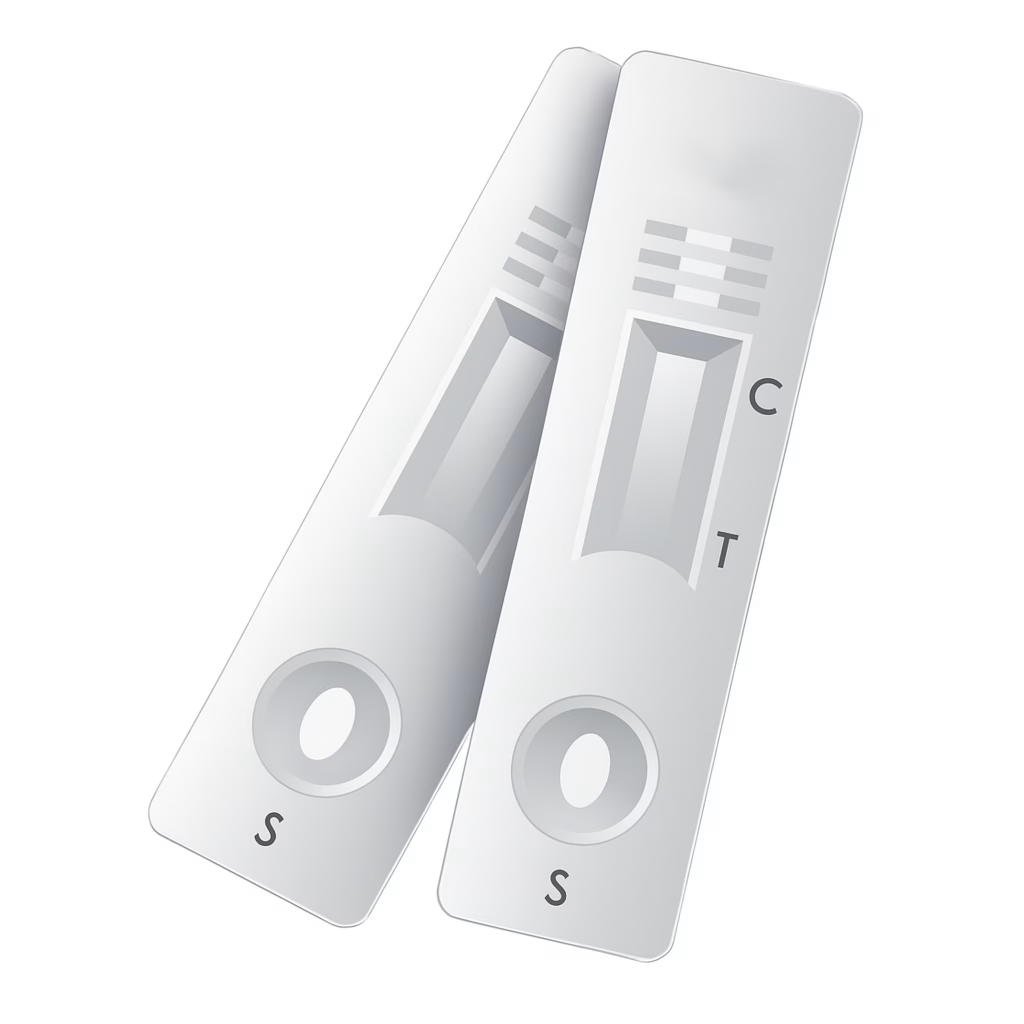
Rapid diagnostic tests (RDTs) are single-use in vitro diagnostic devices that give a result within minutes, usually without an instrument. Most are lateral flow immunoassays: the specimen migrates along a membrane strip, and a colored line forms where labeled antibodies or antigens capture the target. A control line shows that the specimen migrated as intended.
The World Health Organization describes in vitro diagnostics as tests that can detect disease, conditions and infections, and notes that point-of-care tests can be performed near or at the point of patient care. RDTs are the part of that family built for use close to the patient. Our guide to lateral flow tests explains the strip chemistry, and how lateral flow assays work follows a specimen step by step.
Formats: cassette, strip and midstream
Common formats of lateral flow rapid tests
| Format | How the specimen is applied | Where it is typically used |
|---|---|---|
| Cassette | Drops of specimen, and buffer where required, are added to a sample well in a plastic housing. | Blood, serum, plasma and swab-extract tests. The housing protects the strip. |
| Strip (dipstick) | The bare strip is dipped into the specimen or an extraction tube up to a marked line. | Urine and extracted swab specimens. |
| Midstream | An absorbent tip in a pen-shaped housing is held in the urine stream or dipped into a collected sample. | Urine hormone tests such as hCG. |
General description. The insert states the specimen types and procedure for each product.
What RDTs detect: four analyte types
- Antigen tests detect a component of the pathogen itself, such as hepatitis B surface antigen in the ATFirst™ HBsAg rapid test.
- Antibody tests detect the patient’s immune response (IgG, IgM or both). Antibodies take time to appear and can persist after an infection has resolved, so an antibody result alone does not date an infection.
- Hormone tests detect a hormone above a set concentration, most commonly hCG in urine.
- Protein marker tests detect proteins such as cardiac troponin I, C-reactive protein or tumor-associated markers above a cut-off.
Strengths and limits compared with laboratory methods
The strengths are practical. An RDT needs no analyzer and little bench space, and the result is available during the same patient visit. Single-use devices suit low test volumes and sites without a laboratory.
The limits matter just as much:
- Most RDTs are qualitative. They report presence or absence at a cut-off, not a concentration.
- Analytical sensitivity is generally lower than that of laboratory immunoassays or nucleic acid tests, so low concentrations of the target, for example early in infection, can give a negative result.
- Visual reading is subjective when a line is faint, and there is no automatic record of the result.
- A result is an aid to diagnosis. It must be interpreted by a clinician with other clinical and laboratory findings.
How to evaluate a rapid diagnostic test
- Intended use. Read the intended-use statement: the analyte, the intended user, the purpose and the population.
- Specimen. Check which specimen types were validated (fingerstick or venous whole blood, serum, plasma, swab, urine), the volume needed and any anticoagulant restrictions.
- Sensitivity and specificity, against what. A figure means little without the comparator method, the number and type of specimens, and who ran the study. Agreement with another rapid test is not the same as agreement with a laboratory reference method.
- Storage. Confirm the storage temperature range, the shelf life remaining at delivery and the reading window after the specimen is applied.
- Documentation. Ask for the current instructions for use, evidence of regulatory status in your market, the manufacturer’s quality certificate and lot-specific records.
First Diagnostic™ Corporation brands and distributes lateral flow rapid tests made by established IVD manufacturers, for professional in vitro diagnostic use. Compare the range in the rapid tests catalog, download inserts from product inserts, and see quality and regulatory information for documentation. For where these tests are used, see point-of-care testing, or contact us.
Frequently asked questions
Are rapid diagnostic tests as sensitive as laboratory tests?
Generally not. Laboratory immunoassays and nucleic acid tests usually detect lower concentrations of the target. That is why the comparator method in a product insert matters.
Can an RDT be read after the time stated in the insert?
No. Read the result within the window given in the instructions for use. Lines that appear or change after that window should not be interpreted.
Does a negative result rule out infection?
No. A negative result means the target was not detected in that specimen at that time. The clinician decides whether repeat or laboratory testing is needed.
Keep reading
- Lateral flow tests explained — How the strip, labels and lines work.
- Point-of-care testing: where rapid tests fit — Settings and quality practices for testing near the patient.
- Fluorescent vs gold nanoparticle labels — How the label choice affects reading and instruments.
- Digital cassette readers for lateral flow tests — What readers add to visual reading, and their limits.
References
- World Health Organization. In vitro diagnostics (health topic page). Accessed October 2026. who.int
- Regulation (EU) 2017/746 of the European Parliament and of the Council of 5 April 2017 on in vitro diagnostic medical devices, Article 2 (definitions). EUR-Lex. eur-lex.europa.eu
Source: First Diagnostic™ editorial team · Last reviewed: October 2026 · First Diagnostic™ editorial team
Regulatory status: Products shown on this website are for professional in vitro diagnostic use. They are not cleared, approved or authorized by the U.S. Food and Drug Administration and are not offered for sale in the United States. Product availability and regulatory status vary by country; contact us for the status in your market.