
Resource center · Early cancer diagnostics
The future of cancer screening: established methods and methods on trial
The future of cancer screening is often described in terms of blood tests and AI. This guide separates what screening programmes use today from what is still being evaluated.
- Educational guide
- Reviewed October 2026
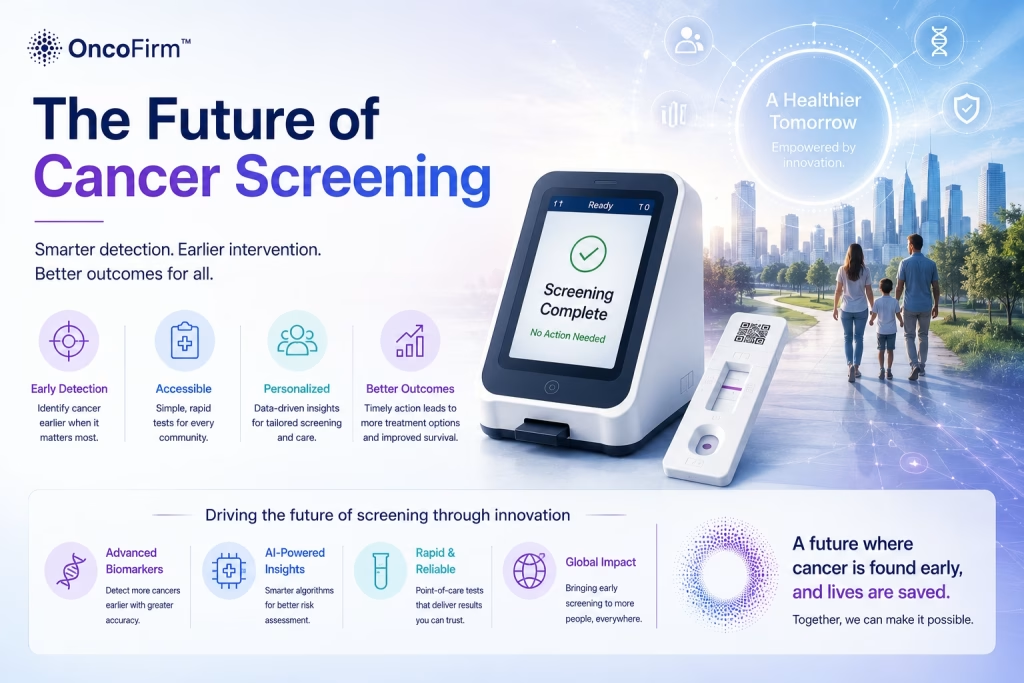
What the future of cancer screening builds on
Any view of the future of cancer screening should start from what has been shown to work. The World Health Organization (WHO) describes screening as testing people without symptoms to find cancer or pre-cancer early, and distinguishes it from early diagnosis, which concerns people who already have symptoms.
WHO’s European office states that mass population screening can be advocated only for cervical, breast and colorectal cancer, and that lung screening is considered only for heavy smokers. WHO lists the HPV test as the preferred method for cervical screening, and mammography for breast screening in a defined age group where health systems are strong enough to support it.
WHO also sets conditions. A programme should go ahead only when its effectiveness has been demonstrated, when resources cover nearly all of the target group, and when facilities exist to diagnose and treat those who test positive.
The harms every new screening test is measured against
Screening tests are given to people who feel well, so harms count as much as benefits. WHO names four:
- False positives, which lead to additional testing, invasive procedures and anxiety.
- False negatives, which give false reassurance and can delay presentation.
- Overdiagnosis, the finding of slow-growing cancers that would never have caused symptoms.
- Overtreatment, meaning treatment that was not needed.
Finding more cancers is therefore not the measure of success. The question for any new method is whether fewer people die of the disease, and at what cost in harm. Background is in why early detection matters.
Multi-cancer early detection blood tests
Multi-cancer early detection (MCED) tests, also called multi-cancer detection tests, look in a blood sample for signals from many cancer types at once. According to the U.S. National Cancer Institute (NCI), the signals measured include changes in DNA or RNA sequence, patterns of DNA methylation, patterns of DNA fragmentation and levels of protein biomarkers. These are laboratory tests, not lateral flow tests; the methods are described in liquid biopsy explained.
The NCI is direct about the evidence. It is not known whether the benefits of screening with these tests outweigh the harms, and no definitive clinical trial has shown that they reduce cancer deaths. The NCI also notes that the tests are better at detecting later-stage cancers than earlier-stage cancers, and that a positive result must be followed by further tests, which may be invasive, to confirm a diagnosis.
The NCI’s Cancer Screening Research Network has set up the Vanguard study to assess feasibility and inform the design of a larger trial. Meanwhile the NCI advises that standard screening remains recommended whether or not a person has had such a test. Regulatory status differs by test and by country and changes over time, so it should be checked with the national authority.
Risk-based screening
Screening already uses risk. WHO notes that people are selected for programmes on the basis of age and risk factors, in order to avoid excessive false positives. Restricting lung screening to heavy smokers is an example.
Risk-based screening extends the idea by adjusting who is screened, how often and by which method according to an individual’s estimated risk. Inputs under study include family history, inherited variants, previous results and imaging features. The reasoning is sound, but a risk model has to be validated in the population where it will be used, and a tailored schedule has to be shown to perform at least as well as the standard one before replacing it.
AI support in screening programmes
Software that assists image reading is the most developed use of AI in screening. The NCI reports that AI can process mammograms rapidly and that imaging algorithms have been studied both for detecting breast cancer and for predicting long-term risk. It also states the conditions: models trained on data that are not representative can perpetuate bias, and further randomized trials are needed to validate AI applications in clinical practice.
AI in screening is therefore a reading aid inside an existing programme, not a new screening test. See AI in cancer diagnostics.
Established and investigational approaches compared
Status of screening approaches according to the sources listed below
| Approach | Status | Main open question |
|---|---|---|
| Organized screening for cervical, breast and colorectal cancer | Established; advocated by WHO where health systems can support it | Covering the whole target group with adequate follow-up |
| Lung screening for heavy smokers | Used for a defined high-risk group | Selecting people by risk |
| MCED blood tests | Under evaluation in trials | Whether they reduce cancer deaths, and at what level of harm |
| Risk-based schedules | Age and risk factors already used; wider tailoring under study | Validation of risk models in each population |
| AI reading support | A reading aid; further randomized trials called for | Effect on patient outcomes; bias |
Sources: WHO fact sheets and National Cancer Institute pages listed in the references.
Where First Diagnostic fits
First Diagnostic™ Corporation distributes rapid tests for professional in vitro diagnostic use. Its range includes qualitative PSA, CEA and AFP tests, listed with the tumor-marker and general health rapid tests; these are aids used alongside other clinical and laboratory findings and are not cancer screening or diagnostic tools. The company’s interest in rapid cancer-marker testing and digital cassette readers is a longer-term goal, and nothing in this area is available yet. For questions about the current catalog, contact First Diagnostic.
Frequently asked questions
Will blood tests replace existing cancer screening?
Not on current evidence. The NCI advises that standard screening remains recommended whether or not a person has had a multi-cancer detection test, and no definitive trial has shown that these tests reduce cancer deaths.
Why is finding more cancers earlier not automatically a benefit?
Some cancers found by screening grow so slowly that they would never have caused symptoms, and finding them leads to treatment that was not needed. A screening method is judged by whether it reduces deaths, weighed against false positives, overdiagnosis and overtreatment.
What is risk-based screening?
It means matching the screening offer to a person’s estimated risk instead of offering the same test at the same interval to everyone in an age band. Selection by age and smoking history is already used; broader tailoring is still being studied.
Are rapid tumor-marker tests cancer screening tests?
No. Qualitative tumor-marker rapid tests are aids for clinicians to use with other findings. They are not validated for screening people without symptoms.
Keep reading
- Lateral flow tests explained — The pillar guide to how lateral flow rapid tests are built, read and evaluated.
- Why early detection matters — Stage at diagnosis, early diagnosis versus screening, and the evidence required.
- Liquid biopsy explained — What blood-based tumor DNA testing measures and where it is used.
- AI in cancer diagnostics — Where diagnostic software is used, how it is regulated and what its limits are.
- What are cancer biomarkers? — Types of biomarker, what they are used for and why few are suitable for screening.
References
- World Health Organization Regional Office for Europe. Cancer – Screening and early detection (fact sheet). who.int
- World Health Organization. Cancer (fact sheet). who.int
- National Cancer Institute, Division of Cancer Prevention. Questions and Answers about Multi-Cancer Detection Tests. prevention.cancer.gov
- National Cancer Institute. Screening for Many Cancers with One Test: Uncertainty Abounds. Cancer Currents, April 21, 2022. cancer.gov
- National Cancer Institute. AI and Cancer. cancer.gov
Source: First Diagnostic™ editorial team; sources listed above · Last reviewed: October 2026 · First Diagnostic™ editorial team
Regulatory status: Products shown on this website are for professional in vitro diagnostic use. They are not cleared, approved or authorized by the U.S. Food and Drug Administration and are not offered for sale in the United States. Product availability and regulatory status vary by country; contact us for the status in your market.